🌐 Machine-translated from Russian. Show original
ad-tools-core — the common core of the AD Tools series services (directory, organizational structure, password reset, LAPS, negotiators, and others). The code for connecting to Active Directory, logins, sessions, limits, logs, and notifications lives in one place and is broken down into services by the sync.mjsscript. A bug only needs to be fixed once.
🔒 Since 17.11.2026, the source code of the AD Tools series is provided upon request: leave a request. The showcase of the series is github.com/WorkTime-kz/ad-tools.
| Link |
|---|
| 🧩 | ad-tools-core — source code and documentation |
| 🧪 | Test bench — ad-testlab |
| 📦 | Installation of the entire series — ad-tools-suite |
In this part:
Why
Looking for:тестировщики с Windows Server ADпроверка SSO в Edge и Chromeревью криптографии Kerberosконтрибьюторы
🌐 Machine-translated from Russian. Show original
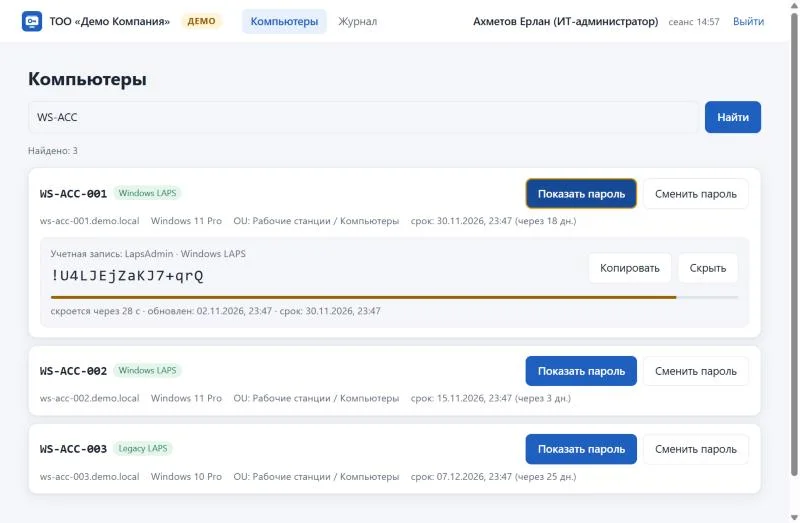
AD LAPS is a web portal for support and administrators: find a computer, view the local administrator password from Windows LAPS or legacy Microsoft LAPS, forcibly change it — with a mandatory reason and a log protected by a hash chain. It is deployed within the company network and is not published on the internet. Part of the AD Tools series.
🔒 Since 17.11.2026, the source code of the AD Tools series is provided upon request: leave a request. The showcase of the series is github.com/WorkTime-kz/ad-tools.
| Link |
|---|
| 🔐 | AD LAPS — source code and instructions |
In this part:
What's New (November 2026)
Briefly, what has changed since November 13:
Looking for:тестировщики с реальным AD и LAPSконтрибьюторыобратная связь от админов и безопасников
🌐 Machine-translated from Russian. Show original
AD Access is a self-service portal for access to Active Directory groups. The employee requests access to a folder, system, or service themselves, the resource owner approves the request, the service account adds the employee to the AD group, and temporary access is revoked automatically after the deadline. Once every N days, owners confirm who still needs access, and the auditor receives the log and reports in CSV. It is deployed within the company — without publishing on the internet and without a database. Interface — in Russian and Kazakh.
🔒 Since 17.11.2026, the source code of the AD Tools series is provided upon request: leave a request. The showcase of the series is github.com/WorkTime-kz/ad-tools.
| Link |
|---|
| 🔐 | AD Access — source code and instructions |
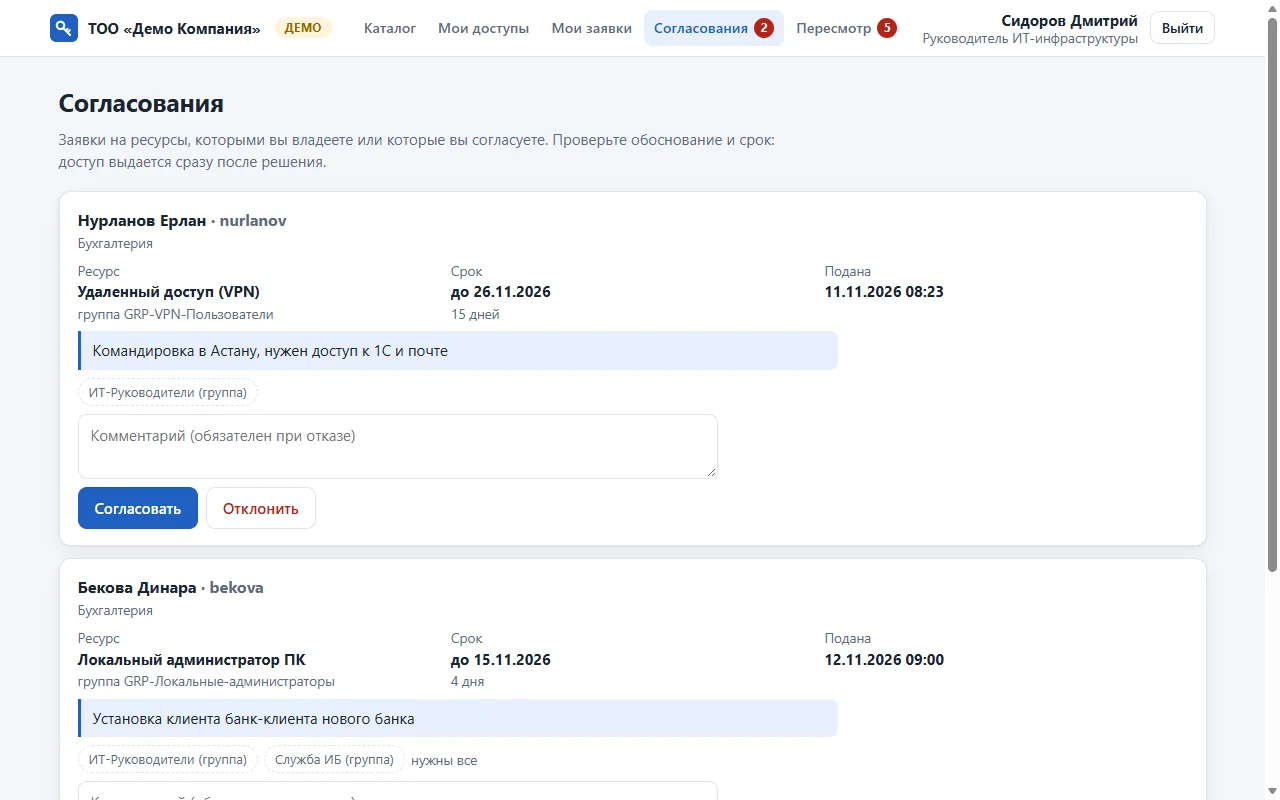
In this part:
What's New (November 2026)
Version 1.1.0. Briefly, what has changed since November 13:
Looking for:тестировщики с реальным ADконтрибьюторыобратная связь от админов, безопасников и аудиторов
🌐 Machine-translated from Russian. Show original
AD SSPR is a portal where an employee changes the domain password themselves, resets the forgotten password, and unlocks their Active Directory account — without calling IT support. It is deployed on an internal server: no internet, external services, CDN, or database required.
🔒 Since 17.11.2026, the source code of the AD Tools series is provided upon request: leave a request. The showcase of the series is github.com/WorkTime-kz/ad-tools.
| Link |
|---|
| 🔑 | AD SSPR — source code and instructions |
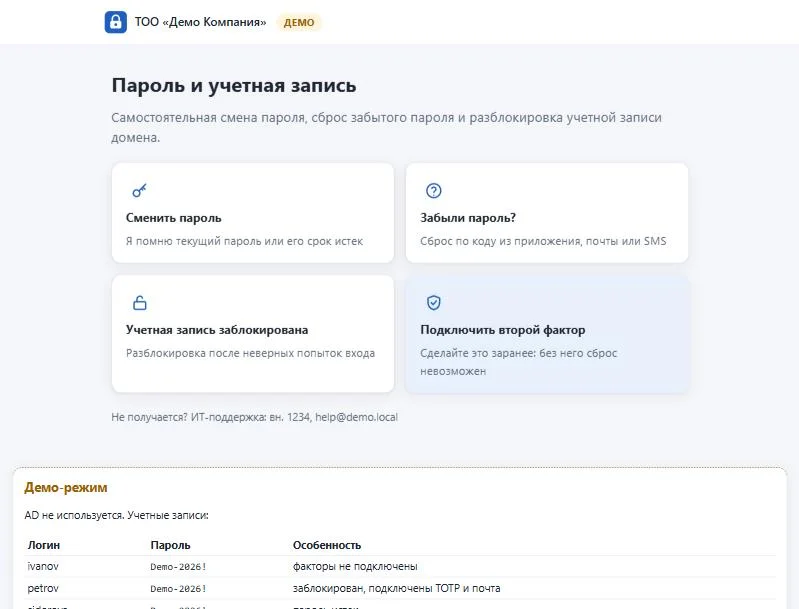
In this part:
What's New (November 2026)
Briefly, what has changed since November 13:
Looking for:тестировщики с реальным ADконтрибьюторыобратная связь от админов и безопасников
🌐 Machine-translated from Russian. Show original
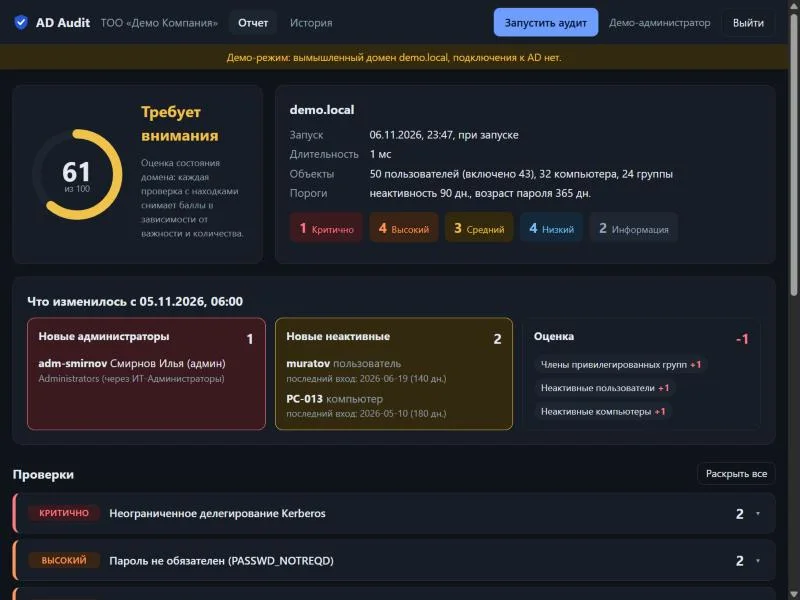
AD Audit is a tool that checks the Active Directory domain for typical weak spots and shows a clear report: what was found, why it is a risk, what to do, and which team should fix it. It operates within the company network, without internet, external services, or CDNs.
🔒 Since 17.11.2026, the source code of the AD Tools series is provided upon request: leave a request. The showcase of the series is github.com/WorkTime-kz/ad-tools.
Read only. AD Audit changes nothing in AD. Correction commands (Disable-ADAccount, Set-ADUser , etc.) are only shown — the administrator checks and executes them themselves.
| Link |
|---|
| 🛡️ | AD Audit — web dashboard and Lite in one repository |
In this part:
What's New (November 2026)
Briefly, what has changed in the panel since November 13:
Looking for:тестировщики с реальным ADконтрибьюторыобратная связь от админов
🌐 Machine-translated from Russian. Show original
In this part:
Network and access
- Listen only to the required interfaces (
listen_addresses), port 5432 is closed ufw to everyone except application servers.
- In
pg_hba.conf — specific databases, roles, and addresses instead of all all 0.0.0.0/0. For network connections — hostssl and scram-sha-256.
- No
trust in network lines. Even "temporarily."
- External admin access is only via VPN or SSH tunnel.
Passwords: escaping with md5
Check which roles still store passwords in the old format:
SELECT rolname FROM pg_authid WHERE rolpassword LIKE 'md5%';
For each such role at password_encryption = 'scram-sha-256' , simply reset the password (\password имя), then replace md5 with scram-sha-256 in pg_hba.conf. In PostgreSQL 18, md5 passwords are declared expired, and warnings are displayed when used — support is planned to be removed in one of the next versions.
TLS with a normal certificate
🌐 Machine-translated from Russian. Show original
In this part:
How mail is usually hacked
| Attack | What the | looks like How to defend |
|---|
| Password phishing | "Your inbox is full, log in with link" → fake MFA login page | , training, link filter, |
| Sender substitution | "director's" email from your own domain | DMARC p=reject |
| Similar domain | company-kz.com, cornpany.kz | tag "external sender", training, monitoring domain registrations |
| BEC (business correspondence compromise) | a compromised supplier mailbox says "we have new details" | a call to a known number before changing the details |
| Malicious attachments | "act сверки.zip," documents with macros, | block of dangerous types, sandbox, banning macros from the internet |
| Password brute force | thousands of IMAP/SMTP | MFA login attempts, disabling legacy protocols, IP |
| Session token theft | phishing proxy intercepts an already authorized session | FIDO2/passkeys, conditional access over the device |
MFA — for everyone, without exception
🌐 Machine-translated from Russian. Show original
In this part:
Processor
CPU model. host-passthrough gives the VM all host processor instructions — maximum speed. If VMs will migrate between different servers — use the common model (host-model or named one, for example EPYC, Skylake-Server).
Core binding (CPU pinning) for heavy VMs (DBMS, 1C):
lscpu -e                            # ядра, NUMA-узлы и потоки
virsh vcpupin db01 0 4
virsh vcpupin db01 1 5
virsh emulatorpin db01 0-1
To secure it permanently — the section <cputune> in virsh edit. Rules: keep the VM in one NUMA node, do not give it the cores on which the host runs, and do not share the "threads" of one kernel among different heavy VMs.
Memory
- Hugepages (2 MB or 1 GB pages) reduce overhead for large VMs:
echo 'vm.nr_hugepages = 8192' | sudo tee /etc/sysctl.d/90-hugepages.conf   # 8192 × 2 МБ = 16 ГБ
sudo sysctl --system
<memoryBacking><hugepages/></memoryBacking>
- Ballooning allows the host to take unused memory from the VM — convenient for test benches but not for databases.
- KSM (Identical Page Merging) saves memory for many identical VMs but consumes the processor and theoretically opens attacks through third-party channels — enable it consciously.
Discs
virtio-scsi instead of virtio-blk — if you need many drives and TRIM.- IOThreads offload the main VM flow during intensive input-output:
🌐 Machine-translated from Russian. Show original
In this part:
Step-by-step installation
Boot from a flash drive (the boot menu is usually F11, F12, F8, or Esc when powered on) → Try or Install Ubuntu Server.
- Language — English. Error messages in English are easier to find in search.
- Layout — English (US).
- Installation type — Ubuntu Server (not minimized).
- Network — select the wired interface → Edit IPv4 → Manual:
- Subnet:
192.168.1.0/24
- Address:
192.168.1.10
- Gateway:
192.168.1.1
- Name servers:
192.168.1.1,1.1.1.1
- Proxy — empty, Mirror — leave the suggestion.
- Disk — Use an entire disk, check Set up this disk as an LVM group. Important: by default, the installer gives the root only part of the space. On the Storage configuration screen, select
ubuntu-lv → Edit → set the size larger (for example, 100 GB for the system; the rest will be left for VM in part 4).
- Profile — name, server name (
kvm01), your login (not admin and not root), strong password.
- Ubuntu Pro — Skip for now (let's return in part 7).
- SSH — ✅ Install OpenSSH server. If you have a key on GitHub, you can import it immediately.
- Featured snaps — don't choose anything.
- Wait for Reboot Now, remove the flash drive.
First SSH login
From your computer:
ssh ivan@192.168.1.10
🌐 Machine-translated from Russian. Show original
In this part:
What cannot be sent to public services
- Passwords, API keys, tokens, certificates — even "for a moment to fix the config."
- Personal data: full name with IIN, phone numbers, addresses, medical information, data of candidates and employees. Databases with personal data of citizens of the Republic of Kazakhstan must be stored in Kazakhstan (more details), and neural network services process requests abroad.
- Trade secrets: contracts, financial data, client databases, NDA source code.
- Client data — if the contract with the client restricts this.
How to work safely
- Anonymize: replace names, IINs, amounts, and company names with conditional ones.
- Minimize: send the code or log snippet related to the issue, not the entire repository.
- Corporate rates and contracted services where data usage for training is disabled — for work tasks.
- Local models — for sensitive data (part 2.
Risks besides leaks
🌐 Machine-translated from Russian. Show original
In this part:
Why it matters
Cameras and dashcams are computers with network access. Devices with factory passwords, old firmware, and abandoned internet ports are regularly hacked with mass scanners: the image is seen by outsiders, and the device becomes the entry point into the company's network.
Three ways to access remotely
| Method | Pros | Cons |
|---|
| Manufacturer cloud (P2P): Hik-Connect, DMSS, etc. | fast, without router configuration, | video and management are done through the manufacturer's service |
| Port blogging on the router | simply | the device is open to the entire internet — not recommended |
| VPNs (WireGuard, IPsec, OpenVPN) | devices are not visible from the internet | router or server configuration is required |
A VPN is optimal for business: remote browsing works like from an office, and the dashcam is not visible from outside. WireGuard setup — in the "Small Business Infrastructure" series.
Protection checklist
Accounts
Network
🌐 Machine-translated from Russian. Show original
In this part:
Why people are attacked
Technical protections are improving, so scammers increasingly attack people: it's easier to convince an accountant to pay a bill than to hack a client bank. Social engineering puts pressure on urgency, authority , and fear.
Typical scenarios against companies
| Scenario | What the | Protect | looks like
| --- | --- | --- |
| Substituting details | a letter "from the supplier": "we have a new invoice, pay here" | confirmation by calling a known number |
| 'Letter from the director' | 'pay urgently, I'm at a meeting, don't call' | rule: urgent payments by mail are not processed without a call |
| Phishing | a link to "mail login" or "document" on a similar domain | 2FA, training, mail filters, SPF/DKIM/DMARC, |
| Call "from IT support" | "dictate the code from SMS, we fix the mail" | codes are not shared with anyone, support does not ask |
| Call 'from the bank' or 'authorities' | 'they are issuing a loan to you, transfer money to a secure account' | the bank and government agencies don't do this — hang up and call back from the | website
Scenarios versus clients
Scammers use your brand against your clients: fake websites, "support" accounts in messengers, calls on behalf of the company. What can be done:
🌐 Machine-translated from Russian. Show original
In this part:
Logic
- Input chain — traffic directly to the router (Winbox, DNS, VPN).
- Forward chain — traffic through the router between networks and to the internet.
- Rules are checked from top to bottom, and the first matching one is triggered.
- Principle: allow what is necessary, forbid the rest.
Basic rule set
/ip firewall filter
add chain=input action=accept connection-state=established,related,untracked comment="input: established"
add chain=input action=drop connection-state=invalid
add chain=input action=accept protocol=icmp
add chain=input action=accept in-interface-list=LAN comment="input: из LAN"
add chain=input action=accept protocol=udp dst-port=13231 comment="input: WireGuard (часть 3)"
add chain=input action=drop comment="input: все остальное"

add chain=forward action=fasttrack-connection connection-state=established,related hw-offload=yes
add chain=forward action=accept connection-state=established,related,untracked
add chain=forward action=drop connection-state=invalid
add chain=forward action=drop connection-state=new connection-nat-state=!dstnat in-interface-list=WAN comment="forward: из интернета только проброшенное"
⚠️ Add rules to Safe Mode and first allow the LAN rule, otherwise you may lose access to the router.
Port clearance — caution
/ip firewall nat add chain=dstnat in-interface-list=WAN protocol=tcp dst-port=443 action=dst-nat to-addresses=192.168.10.20 to-ports=443
🌐 Machine-translated from Russian. Show original
In this part:
Threats to accounts
- Credential stuffing: bots try login-password pairs from other people's leaks. It works because people repeat passwords.
- Password matching for a specific account.
- Mass registrations by bots — for bonuses, spam, and boosts.
- Capture via access restoration: changing email or phone, intercepting a code.
Frequency limitation
The first line of defense includes limits on login, registration, password recovery, and code sending:
- per account: no more than N failed logins within 15 minutes;
- by IP and device: no more than M attempts to different accounts;
- by phone number: no more than K SMS codes per hour — otherwise, scammers use your form for expensive mailings at your expense.
Example of an nginx-level constraint for a login form:
limit_req_zone $binary_remote_addr zone=login:10m rate=5r/m;

location = /api/login {
    limit_req zone=login burst=5 nodelay;
    proxy_pass http://app;
}
Limits at the web server level supplement but do not replace in-app checks: an attacker can change the IP.
Responses that do not help the attacker
🌐 Machine-translated from Russian. Show original
In this part:
Simple anti-fraud system architecture
- Event — registration, login, payment, withdrawal, change of details.
- Signal collection — data about the user, device, network, history.
- Rules and scoring — risk assessment calculation.
- The solution is to skip, request confirmation, send for manual review, or reject.
- Feedback — the result (confirmed or not) is returned to the system for rules configuration.
You can start with a module in your own code and a table in the database — specialized platforms are needed when the volume grows.
Signals
| Group | Examples |
|---|
| Account | account age, whether email and phone number are confirmed, transaction history, |
| Device | is a new device for the account, how many accounts are there |
| Network | IP from a data center or VPN, IP country, matching address |
| Velocity | number of operations per 10 minutes, hour, day, |
| Amount | deviation from the user's regular receipt |
| Contacts | shared phone numbers, addresses, maps, devices with known scammers, |
Use personal data signals within the framework of consent and legal requirements and keep them as long as necessary for protection.
Velocity SQL rules
The most useful rules are about speed. Example: how many different maps were tried on one device in an hour:
🌐 Machine-translated from Russian. Show original
In this part:
Anti-fraud and IB: what's the difference
Information security protects systems from hacking. Anti-fraud protects businesses and clients from abuses, which often occur through legal functions: registration, payment, promotions, refunds. A fraudster does not hack anything — they use the product differently than intended.
Main schemes
| Diagram | What does | Who suffers |
|---|
| Payment fraud | payment with a stolen card, then refunding the owner via bank (chargeback) | store: goods and money lost |
| Account hijacking | logging into someone else's account with a leaked password, withdrawing bonuses, changing details | client and company |
| Abuse of promotions | hundreds of registrations for a "newcomer" bonus, promo codes, referral payments, | marketing budget |
| Fake registrations | bots create accounts for spam, boosting, fake reviews, | reputation, data quality, |
| Return fraud | "item not arrived," empty box return, | store |
| Social engineering | calls and messages "from the bank," substitution of details in emails | clients and employees (part 8 |
| Internal fraud | an employee conducts fictitious transactions or withdraws data | company |
Signs that reveal a scammer
🌐 Machine-translated from Russian. Show original
In this part:
No incident logs are visible
An attack that went unnoticed has been going on for months. The task is to spot suspicious objects, react quickly , and figure out what happened.
What to log
| Event | Why |
|---|
| Logins: successful and unsuccessful, IP, device | password guessing, login from an unusual place |
| Changing rights and roles | enhancing privileges |
| Changing password, email, phone, 2FA, | account capture |
| Changing details, payments, limits, | fraud |
| Exporting and bulk viewing of data | |
| Administrative actions | abuse and errors |
| Access errors (403) | iteration of others' IDs |
Each entry: who, what, when, from where ( IP, device) and result. Passwords, tokens, and full card numbers are not recorded in the log.
Where to store
- Logs are separate from the systems they describe: an attacker with server privileges must not be able to erase them.
- Centralized collection: from a simple syslog server to ELK, Graylog, Loki, or SIEM.
- Retention period — sufficient for investigation (usually several months) and compliant with regulatory requirements in your industry.
Alert signals
Start with a small set, which almost always indicates a problem:
🌐 Machine-translated from Russian. Show original
In this part:
Where Vulnerabilities Come From
Most often—not due to complex errors, but because of forgotten checks: permissions were not checked on the server, input data was not validated, the secret was left in the code. A guide for developers is the OWASP Top 10 list: the most common web application vulnerability classes.
Access control breach
The most common problem: the user sees or changes someone else's data by inserting a different ID into the request.
// ❌ Плохо: доверяем ID из запроса
const order = await db.order.findUnique({ where: { id: req.params.id } });

// ✅ Хорошо: проверяем владельца на сервере
const order = await db.order.findFirst({ where: { id: req.params.id, userId: session.userId } });
if (!order) return notFound();
Rules:
- Each data request checks rights on the server. A hidden button in the interface is not protection.
- Default access is denied, permission is explicitly granted.
- Admin functions — separate routes with separate role verification.
Injections
SQL injections, command injections, XSS — all occur when user data enters the code without processing.
🌐 Machine-translated from Russian. Show original
In this part:
Why Access Matters
Most incidents do not start with hacking by "hooded hackers," but with a stolen or weak password and unnecessary permissions. Access management is the cheapest and most effective protection measure.
Principles
- Personal accounts. No shared "office/123": otherwise, it's impossible to understand who did what, and you can't disconnect one person.
- Minimal rights. Everyone gets access only to what they need to work, and only for the required period.
- Separation of responsibilities. One person does not have to create the supplier alone, enter their details, and make the payment.
- Separate admin accounts. The administrator works under a regular account, and admin only for admin tasks.
MFA: The Second Factor
Two-factor authentication stops the vast majority of stolen password attacks. Include first:
- Mail (through which all other passwords are recovered).
- Client-bank and payment systems.
- Cloud, hosting, domain registrar, DNS.
- Code and CI repositories.
- VPN and remote access.
Reliability of declining factors: hardware keys and passkeys → an authenticator app → SMS. SMS is better than nothing but vulnerable to SIM card reissue.
Passwords
🌐 Machine-translated from Russian. Show original
In this part:
Why the threat model
Without the threat model, security turns into buying random "like everyone else" protection tools. The threat model answers four questions:
- What are we protecting?
- From whom and what could go wrong?
- What do we do about it?
- Is that enough ?
This is not a thick document but a live table that the team reviews with every major change.
Assets: what we protect
Make a list of what loss or leakage will affect the business:
| Asset | Where does | live What happens in the event of an incident |
|---|
| Client base | CRM, 1C, website, | personal data leaks, fines, reputation, |
| Money | client bank, payment gateway, | direct losses |
| Accounting and Accounting | 1C | work stoppages, reporting errors, |
| Source code and secrets | repository, CI, | product compromise |
| Website availability | hosting | loss of sales |
Violators: from whom
- Mass attacks — bots scan the internet for open RDP, old CMSs, and weak passwords. They don't care who you are.
- Scammers include phishing, spoofing details, calls from the bank, and stock abuse.
- Insiders are employees with access: from accidental errors to intentional harm.
- Targeted attacks target large or interesting companies. For most small companies, this is not the main risk.
Start with mass attacks and scammers — they happen to everyone.
STRIDE method for systems